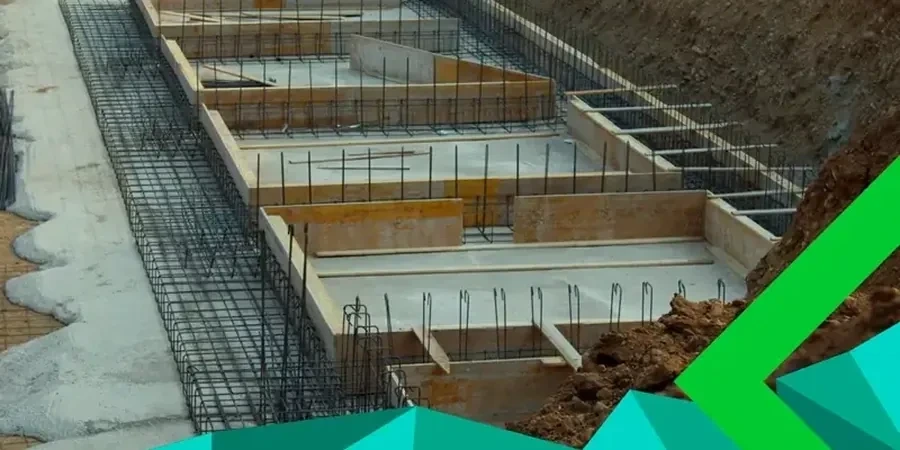
We see it on nearly every project in Portsmouth: a layer of made ground sitting right where you need to place a footing. The city’s historic dockyard expansion and wartime rebuilding left a legacy of fill that ranges from brick rubble to dredged silt, and its behaviour under load is never uniform. A test pit programme across the site gives us the first real look at what lies beneath the surface before we commit to a bearing stratum. On the northern slopes towards Portsdown Hill, the chalk of the White Chalk Subgroup can be surprisingly close to ground level, but weathering grades vary sharply over short distances. Our approach ties site observations to laboratory index testing and direct shear strength parameters, so that every strip or pad foundation is sized for the actual ground conditions, not a textbook assumption.
In Portsmouth, the bearing capacity calculation is only half the story; the other half is verifying that the made ground has been properly removed or treated.
Process overview
Local context
Portsmouth’s development pattern, from medieval harbour to Victorian fortifications and post-Blitz reconstruction, has created a geotechnical patchwork that standard desk studies often oversimplify. The greatest risk we encounter is differential settlement where a new extension spans from a previously excavated and backfilled area onto undisturbed natural clay. Even a 2 mm differential rotation in a short masonry wall can open cracks that are expensive to rectify. We also watch for dissolution features in the chalk on the northern fringe of the city; a seismic refraction survey can quickly flag zones of softened chalk or infilled hollows before we set the footing layout. In the Gunwharf and Port Solent areas, where marine reclamation placed granular fill over estuarine alluvium, we always check for loose zones that could densify under vibration from construction traffic.
Relevant standards
BS 5930:2015+A1:2020 – Code of practice for ground investigations, Eurocode 7 (BS EN 1997-1:2004) – Geotechnical design, BS 8004:2015 – Code of practice for foundations, BRE Special Digest 1 (2005) – Concrete in aggressive ground
Additional services
Bearing Capacity and Settlement Analysis
Analytical and numerical assessment of ultimate and serviceability limit states for pad and strip footings, using undrained and drained parameters from site-specific lab testing, reported with DA1 Combination 1 and 2 factors.
Ground Investigation for Foundation Design
Supervision of trial pits, dynamic probing and CPT soundings to establish the depth to competent bearing stratum, with logging to BS 5930 and sampling for strength and compressibility testing.
Fill Treatment and Verification
Specification for removal and replacement of made ground with compacted engineered fill, including method compaction trials, density testing and plate load proof tests where required.
Typical parameters
Common questions
What is the typical cost range for a shallow foundation design package on a residential extension in Portsmouth?
For a single-storey rear or side extension on a Portsea Island plot, the combined ground investigation, lab testing and foundation design report typically falls between £1,660 and £2,650, depending on the number of trial pits or CPT soundings and the extent of consolidation testing needed on the clay.
How deep do we need to go to get past the made ground in Portsmouth?
There is no single answer because the fill thickness varies from half a metre in parts of Southsea to over four metres in the former dockyard areas. We always start with a trial pit or CPT to physically measure the fill depth and check the natural ground water content before setting the formation level.
Which Eurocode 7 Design Approach do you typically apply for Portsmouth schemes?
We apply Design Approach 1 (DA1), running both Combination 1 and Combination 2 partial factor sets, as this is the UK National Annex recommendation for bearing resistance checks on stiff clay and chalk-derived soils common in the Portsmouth area.