Portsmouth sits on a complex sequence of the Thames Group, primarily London Clay overlying the Lambeth Group, with extensive superficial deposits of brickearth and marine alluvium near the harbour. Groundwater is typically encountered within 1.5 to 3.0 metres of the surface across much of the city, and the tidal influence of the Solent creates fluctuating pore pressures that complicate any deep dig. The city’s density of heritage structures—from the 12th-century cathedral to Victorian naval infrastructure—means that movement tolerances are extraordinarily tight. A geotechnical design of deep excavations here cannot rely on generic assumptions. It demands a site-specific numerical model, often using the Hardening Soil Small-Strain formulation, to capture the real stiffness of London Clay at very small strains. This approach, combined with data from a CPT test to refine the stratigraphic boundaries, allows the team to predict wall deflections and ground settlements before a single bucket of soil is removed.
In Portsmouth's London Clay, the ratio of undrained shear strength to effective overburden pressure can exceed 0.40, allowing steeper temporary cuts than standard charts suggest—if the design accounts for progressive softening.
Process overview
A solid design process begins with a detailed ground investigation to BS 5930:2015, identifying the base of the clay and the top of the water-bearing sand layers. The wall type selection—whether a contiguous bored pile wall, a secant wall or a diaphragm wall—hinges on the required cut-off depth into the Lambeth Group. For sites in Southsea or Old Portsmouth, where vibration limits are strict, a silent piling method or a jet-grouted base plug often becomes part of the solution. The design must also incorporate a dewatering and recharge strategy where excavation monitoring confirms that adjacent structures are not experiencing differential settlement.
Local context
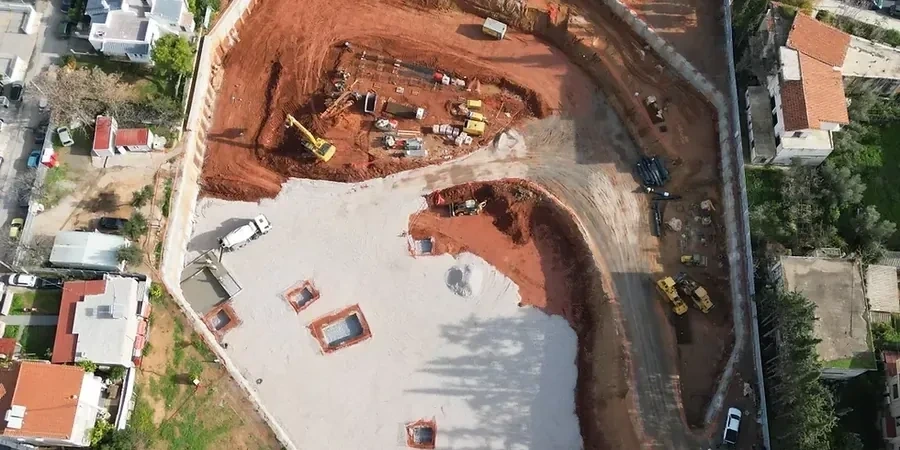
A five-level basement excavation near the Historic Dockyard encountered a loose sand lens within the Lambeth Group at 14 metres depth, unrecorded in the preliminary borehole logs. The inflow of water through the base of the secant pile wall caused a rapid drop in the external piezometric level, settling a neighbouring Grade II listed warehouse by 18 mm in under six hours. The event halted works for three weeks while a forensic review of the grouting programme was undertaken and a supplementary ring of relief wells was installed. This case illustrates that in Portsmouth, the primary risk is not the strength of the London Clay itself but the unpredictability of the Lambeth Group water pressures and the presence of unmapped historic intrusions. A temporary works design must include a realistic assessment of construction tolerances—pile verticality, toe level verification and joint integrity in secant walls—because a small gap in a water-bearing layer can quickly escalate into a major instability problem requiring emergency compaction or compensation grouting.
Relevant standards
BS EN 1997-1:2004 (Eurocode 7 – Geotechnical design, General rules), BS 5930:2015 (Code of practice for ground investigations), CIRIA C760 (Guidance on embedded retaining wall design)
Additional services
Embedded Wall Design and Wall Type Selection
Comparative assessment of secant, contiguous and diaphragm wall options using Plaxis 2D with Hardening Soil Small-Strain parameters derived from advanced triaxial tests on London Clay. Includes prop and waler arrangement design.
Dewatering and Groundwater Control Strategy
Design of deep well systems, ejector wells or vacuum-assisted drainage for the Lambeth Group sands. Incorporates tidal lag analysis and settlement risk assessment for adjacent structures using coupled flow-deformation models.
Temporary Works and Monitoring Specification
Preparation of Category 2 and 3 temporary works designs to BS 5975:2019. Specification of inclinometer arrays, piezometer strings and automated total station monitoring with trigger levels aligned to CIRIA C760.
Typical parameters
Common questions
How much does a geotechnical design for a deep excavation typically cost in Portsmouth?
The fee for a geotechnical design of deep excavations in Portsmouth generally ranges from £1,700 to £6,500 depending on the excavation depth, the complexity of the ground conditions and the number of construction stages to be analysed. A straightforward single-level basement with a cantilever wall falls at the lower end, while a multi-propped excavation near a listed structure, requiring full 2D or 3D finite element analysis, sits at the higher end of the range.
What are the specific challenges of excavating in the Lambeth Group soils found beneath Portsmouth?
The Lambeth Group beneath Portsmouth is highly variable, comprising interbedded stiff clays, dense sands and gravels. The sands can be under artesian pressure, and the interfaces between sand and clay layers are often water-bearing. When the excavation base approaches the top of the Lambeth Group, hydraulic uplift becomes a critical failure mode. The design must verify base stability using the Terzaghi–Peck method and, if the factor of safety is insufficient, incorporate a dewatering system or a jet-grouted plug to prevent a blow-out.
Is a secant pile wall or a diaphragm wall better for a deep excavation in Portsmouth?
The choice depends on depth, groundwater control requirements and proximity to sensitive structures. A secant pile wall is more adaptable to sites with limited headroom and can be installed with smaller rigs, which suits the constrained access of many Portsmouth streets. A diaphragm wall offers greater stiffness and better water tightness for excavations deeper than 15 metres, particularly where the cut-off must penetrate well into the Lambeth Group. Both wall types require rigorous joint integrity testing and a monitoring plan to verify performance during bulk excavation.
What codes and standards govern the geotechnical design of deep excavations in the UK?
The primary design standard is BS EN 1997-1:2004 (Eurocode 7, Part 1), supported by the UK National Annex. Ground investigations are carried out to BS 5930:2015. For temporary works, BS 5975:2019 governs the procedural control. The design of embedded retaining walls follows the guidance of CIRIA C760, which superseded CIRIA C580 and provides updated recommendations on movement limits, prop pre-load and observational method procedures relevant to urban sites like Portsmouth.