Foundations form the literal bedrock of any successful construction project, and in a city like Portsmouth, their importance cannot be overstated. This category encompasses the full spectrum of sub-structure design and assessment, from initial ground investigations and soil analysis to the detailed engineering of shallow and deep foundation systems. Whether you are planning a waterfront residential extension on Southsea seafront, a commercial redevelopment in the historic dockyard, or a new multi-storey structure near the city centre, the stability and longevity of your build depend entirely on a foundation solution that is correctly matched to the specific ground conditions. Getting this critical phase right from the outset mitigates risks of differential settlement, water ingress, and structural failure, ensuring safety and protecting your investment for decades.
The unique geology of Portsmouth presents distinct challenges that demand local expertise. Much of the city, including Portsea Island, is underlain by the London Clay Formation, a stiff, over-consolidated clay that can be susceptible to shrink-swell behaviour with seasonal moisture changes. Overlying this are extensive layers of superficial deposits, notably raised beach and marine gravels, and in low-lying areas, thick sequences of soft alluvium and tidal flat deposits. The water table across the city is typically high, a legacy of its coastal and estuarine setting. This combination of variable drift deposits over a cohesive bedrock, coupled with a shallow groundwater regime, means a desktop study is never sufficient; a thorough, site-specific ground investigation is mandatory to characterise the engineering properties of the soils and design a foundation that will perform reliably.
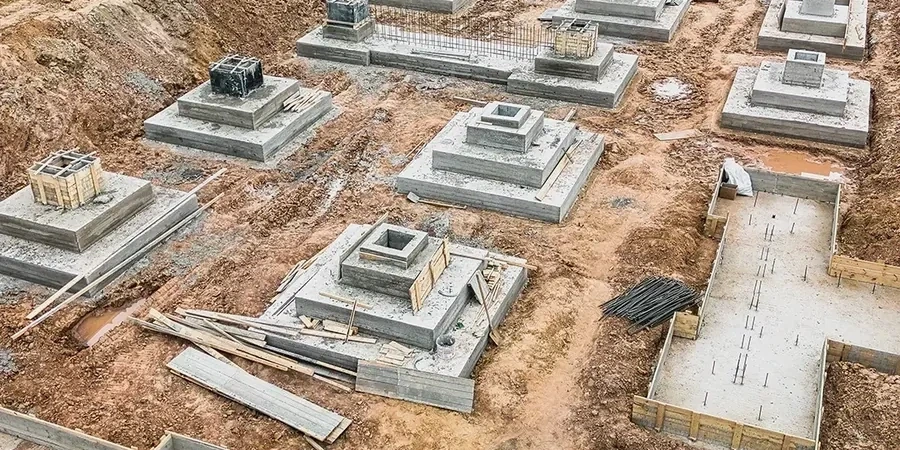
All foundation design and construction in Portsmouth must rigorously adhere to the UK's comprehensive regulatory framework. The paramount standard is Eurocode 7 (BS EN 1997), titled 'Geotechnical design', which is implemented in two parts covering general rules and ground investigation. This is supported by a suite of execution standards, most critically BS 8004 for the code of practice for foundations, and BS 8103 for the structural design of low-rise buildings. For projects involving contaminated land, which is a common consideration on former industrial or dockyard sites, compliance with the Environment Agency's Land Contamination Risk Management (LCRM) guidance is a legal necessity. These documents mandate a limit-state design philosophy, requiring explicit consideration of both ultimate and serviceability limit states, and place a duty on designers to ensure foundations are safe, durable, and suitable for the ground conditions.
The types of projects that demand professional foundation engineering in Portsmouth are exceptionally varied. On a domestic scale, homeowners extending period properties in conservation areas like Old Portsmouth often encounter buried historical structures or poor ground, making a switch from a traditional strip footing to a more robust solution essential. For larger commercial and industrial developments, the deep, compressible alluvium near the harbour necessitates advanced deep foundation techniques, such as pile foundation design, to transfer loads through the weak strata to a competent bearing layer. Infrastructure projects, from the reinforcement of sea defences to the construction of new transport links, rely on retaining structures and specialist ground improvement. Even the installation of a simple garden wall on shrinkable clay soil requires a considered approach to avoid future cracking and movement. In every case, a site-specific design, informed by robust data and local geotechnical knowledge, is the only path to a successful, durable outcome.
Available services
Common questions
Why is a site investigation so critical before designing foundations in Portsmouth?
Portsmouth's geology is highly variable, ranging from soft alluvial clays and silts in low-lying areas to dense gravels and stiff London Clay. A site investigation, compliant with BS EN 1997-2 and BS 5930, is the only way to accurately determine the ground profile, soil strength parameters, and groundwater level. Without this site-specific data, any foundation design is a guess, posing a high risk of unexpected settlement, heave, or bearing capacity failure.
What are the main differences between shallow and deep foundations for a typical Portsmouth project?
Shallow foundations, like strip or pad footings, spread structural loads directly onto near-surface soils and are suitable where competent ground like gravel or stiff clay is present at a shallow depth. Deep foundations, predominantly piles, are required when the near-surface soils are weak and compressible, such as the alluvium near the harbour. Piles transfer loads vertically through these poor layers to a deeper, more competent stratum, providing a reliable solution where shallow foundations would be inadequate.
How does the high water table in Portsmouth affect foundation design?
A high groundwater table, common across Portsea Island, significantly influences foundation choices. It reduces the effective stress and bearing capacity of soils, complicates excavation, and can cause buoyancy issues for deep basements. Design must account for hydrostatic pressures, potential uplift forces, and the requirement for robust waterproofing systems. In some cases, permanent dewatering or the specification of sulphate-resisting cement in concrete may be necessary to ensure long-term durability.
Which British Standards are most relevant for residential foundation construction in Portsmouth?
For residential projects, the key standard is BS 8103, which provides specific guidance for the structural design of low-rise buildings. However, it must be used in conjunction with the general principles of Eurocode 7 (BS EN 1997-1) for geotechnical design and BS 8004 for the code of practice on foundations. Adherence to these standards ensures that the design adequately addresses ground conditions, particularly the risks of clay shrinkage and heave, which are prevalent in the local London Clay.