One of the most persistent errors we see in Portsmouth ground investigations is the reliance on borehole data alone to characterise the complex Quaternary sequences that drape the Chalk bedrock. Portsmouth sits squarely on the Wessex Basin margin, where the London Clay Formation, Lambeth Group sands, and a chaotic mantle of Head deposits and raised beach gravels create a stratigraphic mosaic that defies interpolation from a few metres of core. An exploratory test pit strips away that uncertainty by exposing a continuous vertical face, typically to depths of 3.5 to 4.5 metres depending on stability, allowing our team to log lithological contacts, sample undisturbed blocks from key horizons, and conduct in-situ density or permeability tests directly on the exposed profile. When we combine this visual record with a dynamic probing campaign on the same site, the correlation between SPT N-values and the logged strata becomes far more defensible than any desk-study assumption, which is critical for foundation design where the bearing stratum may be a thin gravel lens rather than the regional Chalk.
A single 4-metre exploratory test pit in Portsmouth's Brickearth can reveal dissolution features that a grid of boreholes might miss entirely, fundamentally changing the foundation strategy.
Process overview
Local context
BS EN 1997-2:2007 places explicit emphasis on the observational method and the validation of the ground model through direct examination, which is precisely the role of the exploratory test pit. In Portsmouth, the risk of overlooking a shallow dissolution feature in the Chalk is not theoretical: the Portsdown Anticline and associated faulting have created zones of enhanced fracturing where solution pipes can develop to diameters exceeding 5 metres, filled with compressible Head or Brickearth. A conventional light cable percussion borehole might terminate upon hitting Chalk refusal at 6 metres, never registering the soft infill of a dissolution pipe that a test pit at 3.5 metres would have exposed laterally. The consequence of founding a pad footing or a ground beam over such a feature is differential settlement that can manifest within the first two years of service. Our pit investigations in Southsea and Copnor have repeatedly identified these hazards during the pre-planning phase, allowing the design team to specify deeper excavation, localised grouting, or a switch to piled foundations before the construction programme is locked in.
Relevant standards
BS 5930:2015+A1:2020 – Code of practice for ground investigations, Eurocode 7: Geotechnical design – Part 2: Ground investigation and testing (BS EN 1997-2:2007), BS 1377-9:1990 – Methods of test for soils for civil engineering purposes – In-situ tests, CIRIA C812 – Manual of soil description and classification
Additional services
Combined Test Pit and Dynamic Probing Investigation
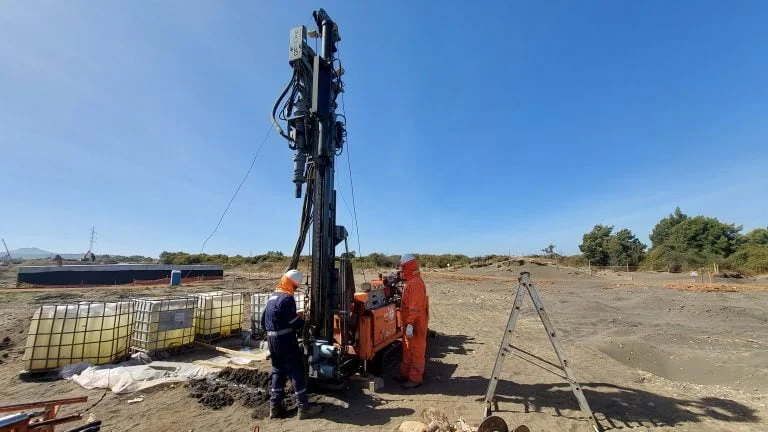
We execute exploratory test pits alongside dynamic probe or SPT boreholes on the same grid, correlating the continuous visual log with penetration resistance profiles. This package is especially effective in Portsmouth's variable Head deposits, where N-values alone can be misleading without lithological context.
In-Situ Permeability and Infiltration Testing
Within the test pit, we perform falling-head or constant-head permeability tests at specific horizons identified during logging. For sustainable drainage (SuDS) design in Portsmouth's new developments, these tests supply the infiltration rates required by Lead Local Flood Authority consultees.
Typical parameters
Common questions
What is the typical cost range for an exploratory test pit in Portsmouth, including reinstatement?
For a standard exploratory test pit in the Portsmouth area, excavated to depths between 2.5 and 4.0 metres, the cost typically ranges from £400 to £580 per pit. This includes mechanical excavation, our engineer's full-time attendance for logging and sampling, high-resolution photographic documentation, and reinstatement with compacted arisings. Factors that can influence the final figure include restricted access requiring a smaller machine, the presence of reinforced concrete hardstanding, deeper dissolution features requiring extended logging time, and the need for a CAT scan survey prior to excavation in areas with dense buried solutions.
How do exploratory test pits complement boreholes in Portsmouth's geology?
Boreholes supply a continuous vertical profile but with a very narrow diameter, typically 100 to 150 millimetres, which means they sample a single point and can miss lateral variations. An exploratory test pit opens a face up to 3.5 metres long, allowing us to observe the continuity of strata, identify lenses and pinch-outs, and measure the orientation of discontinuities. In Portsmouth's Brickearth and Head deposits, where the transition to the underlying Chalk or gravel can be highly irregular, this lateral exposure is often the only way to confirm that a competent bearing stratum extends across the entire footprint of a proposed foundation.
What are the principal health and safety controls for test pits in an urban environment like Portsmouth?
All test pits deeper than 1.2 metres are treated as confined spaces and are subject to a specific risk assessment and method statement. Our standard controls include a CAT and Genny scan before any excavation, support or battering of sidewalls where the ground is unstable, a dedicated banksman, gas monitoring where made ground is encountered, and physical edge protection with stop-blocks for the excavator. In Portsmouth's narrow residential streets and former industrial sites, we also manage public interface with hoarding, permits, and traffic management plans where the pit location is within the highway boundary.
Can you recover undisturbed samples from an exploratory test pit for laboratory testing?
Yes, and this is one of the primary advantages of the method. We cut block samples directly from the pit face, preserving the in-situ structure and moisture content of the soil. These blocks are wrapped, sealed with paraffin wax, and transported to a UKAS-accredited laboratory for triaxial testing, oedometer consolidation tests, or shear box tests. The quality of a block sample from a test pit is generally superior to a U100 tube sample from a borehole in the same material, because the sampling process causes less disturbance to the soil fabric.