Last year we got called to a site off the Eastern Road where a developer had already poured foundations, only to find soft alluvium at 2.4 metres — right where the bearing stratum was supposed to begin. Portsmouth does that. The city sits on a geological patchwork of reclaimed harbour mud, gravel terraces, and the Lambeth Group sands that pinch out unpredictably across Portsea Island. A desk study alone would miss it. You need a soil mechanics study that ties borehole logs to laboratory behaviour: consolidation curves, drained shear strength, and stiffness parameters that actually match what the ground does under load. We run the full suite under BS 5930:2015+A1:2020 and BS EN 1997-1, because on this island, assuming uniform strata is the quickest way to a pile re-drive. When the triaxial results show contractive behaviour in the silts below the water table, the foundation design changes entirely — and that is precisely the kind of call you want before steel is on site.
A reliable ground model in Portsmouth depends on linking in-situ behaviour to lab-measured effective stress parameters — skip that link and you are designing blind.
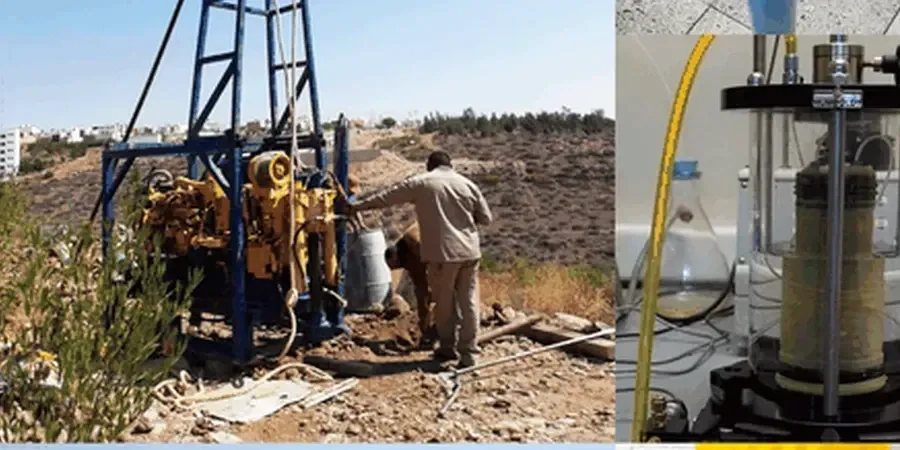
Process overview
Local context
Two sites barely a mile apart in Portsmouth can read like different geological provinces. In Southsea, we often encounter the Wittering Formation — stiff, overconsolidated clays that stand up well in excavation but require careful assessment of shrink-swell potential and long-term pore pressure equilibration. Cross over to Tipner or the north of the M275, and the profile changes to deep sequences of estuarine alluvium with organic content above 6% and undrained shear strengths below 25 kPa. That contrast caught out a contractor on a warehouse job near the ferry port; they had designed for a stiff clay bearing layer at 1.5 metres but hit peat and soft silt to 4.8 metres. The soil mechanics study we performed post-excavation quantified the consolidation settlement that would govern the slab-on-grade decision, and the owner ended up switching to a piled solution. The lesson is blunt: in Portsmouth, ground conditions are a site-specific parameter, not a regional assumption.
Relevant standards
BS 5930:2015+A1:2020 – Code of practice for ground investigations, BS EN 1997-1:2004+A1:2013 – Eurocode 7: Geotechnical design – General rules, BS EN ISO 17892-9:2018 – Consolidated undrained triaxial test with pore pressure measurement, BS EN ISO 14688-1:2018 – Identification and classification of soil
Additional services
Borehole Logging and Sampling
Rotary and window sampling through Portsmouth's made ground and natural strata, with SPTs at 1.5 m intervals and undisturbed U100 tubes in cohesive layers for laboratory strength and compressibility testing.
Advanced Laboratory Testing
Consolidation (oedometer), CIU/CAU triaxial, ring shear for residual strength on shear surfaces in the Wittering clays, and point load testing on chalk cores for foundation bearing capacity verification.
Ground Model and Parameter Derivation
Statistical derivation of characteristic values per Eurocode 7 from lab and field data, including stiffness moduli (E', G0), OCR profiles, and drained/undrained strength envelopes for each engineering unit.
Typical parameters
Common questions
What is the typical cost of a soil mechanics study in Portsmouth for a residential extension?
For a single-storey residential extension on Portsea Island, a soil mechanics study including one borehole to 6 metres, SPTs, laboratory classification, and a factual report typically falls between £2,540 and £4,020 depending on access constraints and the need for undisturbed sampling in cohesive strata.
How do you account for the variability of made ground across Portsmouth when deriving design parameters?
We treat made ground as a separate engineering unit with cautious estimates of density and shear strength derived from SPT correlations, and we always recommend verification through trial pits. Where the made ground thickness exceeds 2 metres, we run consolidation tests on undisturbed samples to quantify settlement potential under foundation loads.
Can your soil mechanics study inform a piled foundation design in the harbour area?
Yes. For piled foundations, we supply undrained shear strength profiles for skin friction calculation in the alluvium, effective stress parameters for the bearing stratum (usually the Lambeth Group sands or chalk), and consolidation data to assess negative skin friction where fill is placing new load on the underlying soft clays.