Contractors in Portsmouth still bring us samples after a failed in-situ test, thinking they can save a day by skipping lab compaction. The thing is, the chalky flint gravels and brickearth around the city don't behave like textbook sand. We see soaked CBR values drop by half when the water table at 1.2 metres gets ignored. A proper CBR road test under BS 5930 gives you a soaked value that reflects what happens after a rainy February on Portsea Island. We run the test at three moisture points to find the critical condition, not just the optimum. If the formation level sits on the Lambeth Group clays, the 4-day soak is not optional. Our team runs the plunger at 1.27 mm/min and plots the force curve to catch any surface irregularity that would void the result. Before sending samples, many engineers complement the exercise with a grain size analysis to confirm the fines content, which directly controls the CBR swell response.
A soaked CBR value under BS 1377-4 is the only number that matters for Portsmouth's high water table. Unsoaked results mislead pavement design by up to 60%.
Process overview
- Soaked CBR at 96 hours per BS 1377-4, mandatory for Portsmouth Basin soils.
- Three-point compaction curve to identify the density-moisture relationship.
- Swell measurement with 0.01 mm resolution tripod dial gauge.
- Force-penetration curve correction for initial concavity.
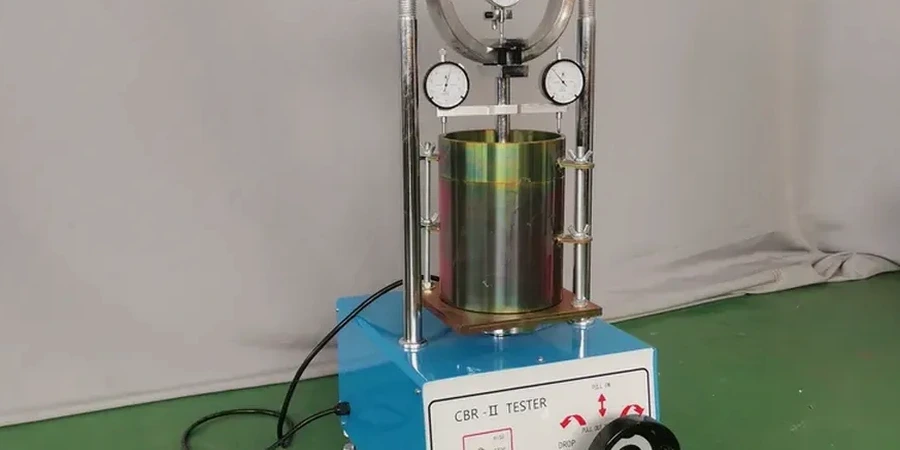
Local context
BS EN 1997-2 (Eurocode 7) expects ground investigation to supply reliable stiffness and strength parameters for the serviceability limit state. In Portsmouth, ignoring the CBR soak stage because 'the site looked dry' is a direct path to pavement failure within two winters. The Portsea Island aquifer rises and falls with the tide, and the upper brickearth can go from stiff to soft in a single wet season. A design based on an unsoaked CBR of 15% that drops to 4% after saturation will rut and crack under traffic loads. We have seen this on industrial estate roads near Hilsea where the formation was clay-rich head deposit. The laboratory CBR test is the only controlled way to quantify that strength loss. The Highway Agency's DMRB and local Portsmouth City Council specifications both require soaked CBR values for flexible pavement thickness design. If you skip the lab test and rely on a DCP correlation in chalk, you're guessing.
Relevant standards
BS 1377-4:1990 – Soaked CBR laboratory test, BS EN 1997-2:2007 – Eurocode 7 ground investigation, Highway Agency DMRB CD 225 – Pavement foundation design
Additional services
Soaked CBR to BS 1377-4
The standard 96-hour soak CBR test with swell monitoring, force-penetration curve, and moisture content determination before and after soaking.
Proctor Compaction
Standard and modified Proctor tests to establish the moisture-density relationship for the material used in the CBR mould.
Particle Size Distribution
Wet and dry sieving plus sedimentation to BS 1377-2, providing the grading curve that controls CBR response and frost susceptibility.
Atterberg Limits
Liquid and plastic limit determination on the fines fraction, which correlates directly with swell potential during the CBR soak phase.
Typical parameters
Common questions
How long does a soaked CBR test take in your Portsmouth lab?
The standard soak is 96 hours. Add one day for sample preparation and compaction, plus another day for the penetration test and report. Total turnaround is typically five to six working days.
What is the typical cost of a laboratory CBR test?
A single-point soaked CBR test with Proctor compaction and swell monitoring is priced between £110 and £150, depending on the number of compaction points and whether we prepare the sample from bulk material.
Can you test chalk and flint gravel from Portsmouth sites?
Yes, we test chalk and flint gravels regularly. For material with particles larger than 20 mm, we follow the scalping procedure in BS 1377-4, replacing oversized particles with an equivalent mass of 20 mm to 37.5 mm material.
Do you report the CBR at 2.5 mm or 5.0 mm penetration?
We report both values. The design CBR is the higher of the two percentages relative to the standard plunger forces. If the 5.0 mm value exceeds the 2.5 mm value, we repeat the test to confirm the curve shape.