Portsmouth sits at an average elevation of just 8 metres above sea level, with much of the city built on low-lying coastal plains and reclaimed land. That elevation figure matters for road builders. High water tables and soft marine deposits beneath Portsea Island mean every flexible pavement design has to manage subsurface moisture from day one. We size the bituminous surfacing, binder course, and granular sub-base to handle the city's 600 mm of annual rainfall without rutting or fatigue cracking. For subdivisions where the formation CBR drops below 2%, we often combine our pavement design with a CBR road analysis to calibrate the layer thicknesses against the actual soaked strength of the subgrade. The traffic loading on the M275 corridor and the heavy port-related haulage routes demands a structural number that works for both commercial vehicles and the Portsmouth City Council adoption requirements.
A flexible pavement design in Portsmouth is only as good as its worst subgrade condition. We design from the bottom up, not the top down.
Process overview
Local context
We bring a lightweight dynamic cone penetrometer onto every Portsmouth pavement job before the grader breaks ground. The DCP gives us a continuous CBR profile in 15 minutes per test point, which is faster than waiting for laboratory soaked CBR results when the formation changes every 20 metres across a former creek bed. The biggest risk we see on the island is differential settlement where old dockyard fill butts against natural gravel terraces. If the sub-base stiffness varies by more than 30% along the alignment, the bituminous layers fatigue prematurely. We map those transitions during the site investigation and either excavate and replace the soft pockets or thicken the granular layer locally. Water ingress at the pavement edge is the second failure mechanism. We detail positive drainage and specify a 150 mm granular shoulder where the road crosses the tidal influence zone around Langstone Harbour.
Relevant standards
DMRB CD 226 – Design for New Pavement Construction, BS EN 13108-1:2016 – Bituminous mixtures. Material specifications. Asphalt Concrete, SHW Series 800 – Specification for Highway Works (unbound mixtures), BS 1377-4:1990 – Soils for civil engineering purposes. Compaction-related tests, Eurocode 1 – BS EN 1991-2:2003 – Traffic loads on bridges (applied to pavement loading)
Additional services
Pavement Structural Design Report
Full design report with traffic loading calculation, CBR-based layer thicknesses, and material specifications per DMRB CD 226. Suitable for Section 38 or Section 278 adoption agreements.
Subgrade Assessment and CBR Testing
In-situ DCP testing, dynamic plate load tests, and laboratory soaked CBR on Shelby tube samples. We deliver a subgrade stiffness profile across the entire road footprint.
Pavement Condition and Residual Life Survey
Deflectograph or falling weight deflectometer (FWD) surveys on existing pavements. We back-calculate layer moduli and estimate the remaining design life for overlay or reconstruction design.
Typical parameters
Common questions
What is the typical cost of a flexible pavement design for a residential road in Portsmouth?
A pavement design package for a residential access road or small cul-de-sac typically falls between £1,340 and £3,710. The final cost depends on the road length, number of CBR test points required, and whether the design must go through a Section 38 adoption process with Portsmouth City Council.
Which design standard do you follow for UK flexible pavements?
We follow the Design Manual for Roads and Bridges, specifically CD 226 (which replaced HD 26/06). For materials, we reference BS EN 13108 for asphalt mixtures and the Specification for Highway Works Series 800 for unbound granular layers.
How do you determine the CBR value for the subgrade?
We use a combination of in-situ dynamic cone penetrometer (DCP) testing and laboratory soaked CBR tests on undisturbed samples. The DCP gives us a continuous profile along the road alignment, and the lab tests calibrate those values for the worst-case saturated condition.
Can you design pavements for heavy port traffic in Portsmouth?
Yes. We design for traffic categories up to 80 million standard axles. For port areas with container handling equipment and frequent HGV movements, we increase the design traffic loading and often specify a stiffer bituminous base layer to handle the concentrated wheel loads.
What is the difference between flexible and rigid pavement design?
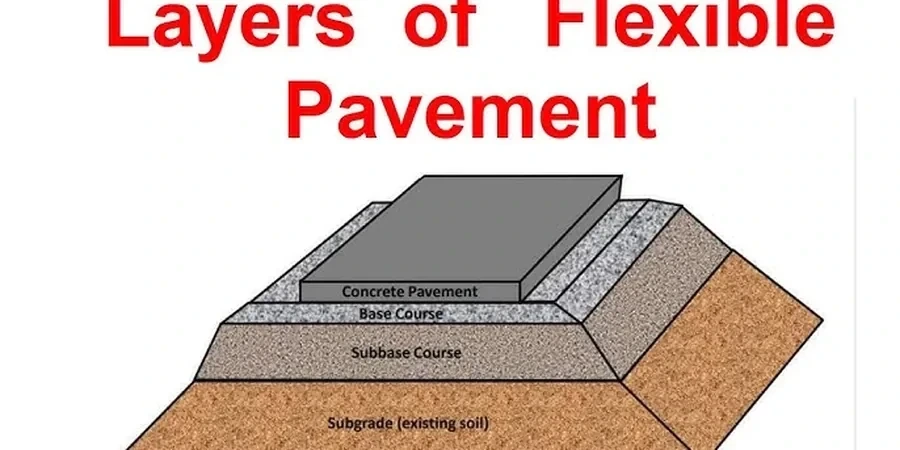
Flexible pavement spreads loads through a layered system of bituminous and granular materials; the stress reduces with depth. Rigid pavement uses a concrete slab that distributes loads over a wide area. Flexible pavements are quicker to repair and easier to stage-construct, which suits the phased development patterns common around Portsmouth.