The hydraulic jack and stressing chair are calibrated and ready on the Portsdown Hill site. Anchoring into the chalk here demands precision—Portsmouth’s Upper Chalk strata can vary by metres across a single project footprint. Our team has designed restraint systems across the city, from the deep excavations near Gunwharf Quays to the retained cuts along the M275 approach. Every anchor we specify starts with a ground investigation that maps flint bands and weathered zones. We then model the bond length against BS 8081:2015 parameters, ensuring the fixed anchor reaches competent chalk below the softened crest. For sites closer to the harbour, where made ground and alluvium overlie the bedrock, we often combine anchor design with a CPT test to pinpoint the interface before selecting the drill method.
An anchor’s capacity in Portsmouth chalk depends more on the flint distribution and fracture spacing than on the intact UCS of the core.
Process overview
Local context
A 14-storey residential project on Marketway faced a 9-metre deep excavation with only 4 metres to the neighbouring Victorian warehouse. Active ground anchors were the only viable restraint. We designed a row of 15-metre long strand anchors at 2-metre centres, inclined at 25° into the Newhaven Chalk. During the suitability test, one anchor crept 2.1 mm per log cycle—just above the BS 8081 threshold. The chalk had a localised solution feature filled with soft clay. We shifted the bond zone deeper and re-grouted under low pressure. Without that iterative testing, the load redistribution across the wall could have triggered differential movement in the adjacent footing. In Portsmouth’s variable chalk, a rigid design without field adjustment is a liability. Each anchor must be treated as a full-scale test.
Relevant standards
BS 8081:2015 – Code of practice for grouted anchors, BS EN 1997-1:2004 – Eurocode 7: Geotechnical design, BS EN 1537:2013 – Execution of special geotechnical work: Ground anchors, CIRIA C760 – Guidance on embedded retaining wall design
Additional services
Active (prestressed) anchor design
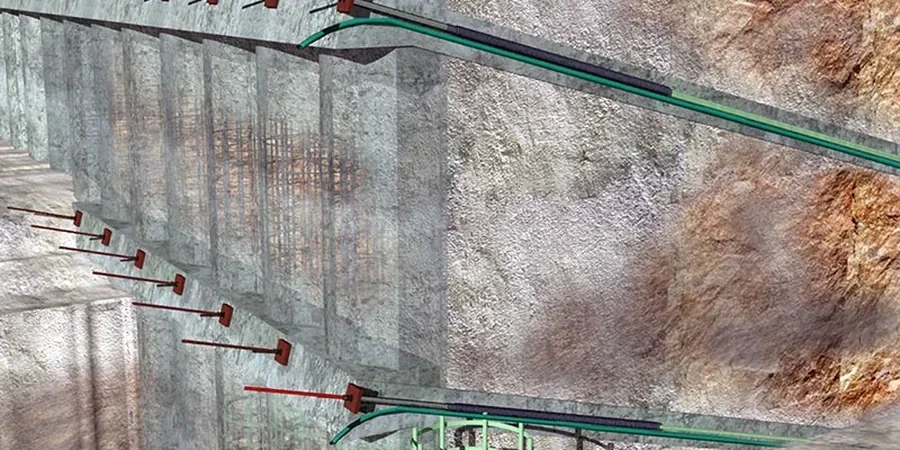
Suitable for retaining walls and deep basements where movement must be controlled from the start. We specify the lock-off load, free length, and bond length based on a limit equilibrium analysis of the wall system. The stressing procedure follows BS EN 1537, with lift-off checks and lock-off recorded at each stage. We design for single and double corrosion protection depending on the service life, using strand or bar tendons.
Passive ground anchor systems
Used in slope stabilisation, rockfall nets, and uplift restraint where load is only mobilised by ground displacement. We design the fixed anchor length to transfer load through friction in the chalk or the gravelly layers of the River Terrace Deposits. The design integrates with the drainage regime—critical on Portsdown Hill where pore pressures fluctuate seasonally and can reduce effective bond stress.
Typical parameters
Common questions
What is the difference between active and passive anchor design?
Active anchors are tensioned against the structure during installation, applying an immediate load to the wall or slab. They control movement from day one. Passive anchors only develop resistance once the ground moves and loads the tendon. In Portsmouth, we use active anchors for basement excavations near sensitive structures, and passive anchors for long-term slope stabilisation on the chalk escarpment.
How do you determine the bond length in Portsmouth chalk?
Bond length is calculated from the ultimate bond stress values in BS 8081:2015, adjusted for chalk grade and fracture spacing. We take site-specific values from pull-out tests on sacrificial anchors. A structured Grade II chalk might give 350 kPa ultimate bond, but a weathered Grade IV zone could drop to 150 kPa. The design bond length includes a factor of safety of 2.5 on the ultimate value.
Do you handle corrosion protection for permanent anchors?
Yes. Permanent anchors in Portsmouth’s saline harbour environment require double corrosion protection per BS 8081. This means a corrugated internal sheath, a cement grout column, and an external corrugated sheath with grout cover. We specify the type of protection based on the aggressivity assessment of the ground and groundwater, tested for chlorides and sulphates.
How much does anchor design and testing cost for a typical project?
A full anchor design package with suitability and acceptance testing typically ranges from £830 to £2,870, depending on the number of anchors and the complexity of the ground investigation. This covers the design report, test specifications, and on-site supervision of the first anchor installations.