Portsmouth sits on a peninsula, with large areas built on reclaimed land and natural marine deposits. The tidal harbour and Southsea seafront conceal a patchwork of loose sands and soft silts that have filled former creeks and marshes over centuries. When a site on Portsea Island shows SPT N-values below 10 in the upper 6 metres, standard fill compaction will not reach the required bearing capacity. Vibrocompaction design steps in to densify these granular soils at depth, reducing the risk of total and differential settlement before foundations are laid. The method uses depth vibrators to rearrange sand grains into a denser state, verified against BS EN 1997-2 field testing. In the Hilsea and Tipner areas, where groundwater sits just 1.5 metres below ground surface, a dry bottom-feed technique often proves essential. A pre-design CPT test campaign gives the continuous cone resistance profile needed to target loose zones accurately and avoid over-compacting already dense layers.
In Portsmouth's saturated sands, achieving 70% relative density at 12-metre depth requires a grid spacing calibrated to CPT tip resistance, not just a generic triangular pattern.
Process overview
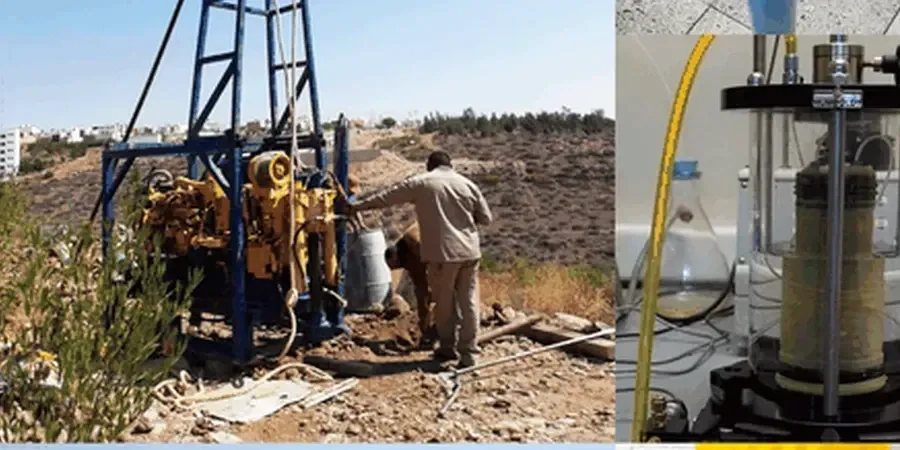
Local context
Portsmouth experiences a tidal range exceeding 4.5 metres, the highest on England's south coast. This daily fluctuation means the groundwater table in coastal fills rises and falls by over a metre, altering the effective stress state in the soil between design and construction phases. A vibrocompaction design that ignores tide-induced pore pressure cycles can leave a site with residual settlement of 15 to 30 millimetres, enough to crack masonry walls and distort door frames. The second risk is buried timber: old dockyard wharves and slipways were built on timber piles and grid foundations now hidden beneath fill. Hitting a submerged timber baulk with a depth vibrator stalls progress and damages the probe. Pre-design test pits at 3-metre spacing along the proposed compaction grid reduce this risk by mapping obstructions before heavy equipment mobilises. The third concern is vibration transmission to neighbouring structures; in the dense terraced streets of Southsea and Fratton, peak particle velocity monitoring at the nearest party wall is a mandatory component of the method statement.
Relevant standards
BS EN 1997-2:2007 (Eurocode 7 – Ground investigation and testing), BS EN ISO 22476-1:2012 (CPT), BS 5930:2015 (Code of practice for ground investigations)
Additional services
Design Specification Package
Full design report including grid layout, energy input per point, lift thickness if backfill is required, water pressure limits, and pass sequence. Compiled to BS EN 1997-1 Design Approach 1 for Portsmouth's coastal ground conditions.
On-Site Trial Compaction
We supervise a trial zone of 4–6 compaction points, measuring CPT resistance before and after each pass to calibrate the design grid. The trial report confirms the number of passes and the effective radius of influence for the specific vibrator model deployed.
Post-Treatment Verification Testing
CPT, SPT, and PMT testing on a 5-metre staggered grid, with statistical analysis of relative density improvement. Load-settlement plots from plate load tests on the treated pad are provided for the foundation designer.
Typical parameters
Common questions
How much does a vibrocompaction design package cost for a residential plot in Portsmouth?
For a single residential plot on Portsea Island, a complete design package including a site visit, CPT interpretation, grid layout, and specification report typically falls between £1,170 and £4,410, depending on plot size and the number of pre-treatment investigation points needed to model the ground.
Can vibrocompaction be used near existing houses in Portsmouth's terraced streets?
Yes, but it requires a vibration impact assessment and continuous peak particle velocity monitoring at the nearest foundation. The design must include a setback distance—typically 5 to 8 metres from party walls—and may specify a reduced vibrator frequency for points within the zone of influence. A condition survey of adjacent properties is recommended before work starts.
How do you verify the ground has been compacted enough?
We run a series of CPT soundings on a staggered grid across the treated area, comparing cone resistance and sleeve friction before and after compaction. The acceptance criterion is a relative density above 70%, confirmed by correlation with the CPT data. Additional SPT tests or pressuremeter tests are added if clay lenses are suspected.
What depth of treatment is needed for a typical Portsmouth brownfield site?
For former industrial plots around Tipner and Hilsea, the loose fill layer usually extends to 8–12 metres. The design depth is set to reach through the entire fill and into the natural dense sand or gravel beneath, with an additional 1-metre penetration into competent strata to ensure no soft toe remains.