Tunnelling through Portsmouth's harbour silts and Bracklesham Beds demands rigorous laboratory characterisation under BS EN 1997-2:2007. The city sits on Portsea Island, where the superficial geology transitions from Wittering Formation sands in Southsea to soft alluvial clays beneath the naval dockyards—materials that exhibit low stand-up time and high sensitivity to pore pressure changes. Our laboratory programme quantifies undrained shear strength through triaxial testing, consolidation parameters via oedometer cells, and particle size distribution following BS 1377 methods. For projects near the M275 corridor or the Gunwharf Quays development, where tunnel alignment intersects made ground and natural soft clays, we couple the laboratory data with CPT profiling to validate stratigraphic boundaries before face pressure calculations begin, ensuring the earth pressure balance machine operates within the narrow margin these soils demand.
Portsmouth harbour clays typically exhibit undrained shear strengths of 18 to 45 kPa—narrowing the margin between face stability and blowout during EPB operation.
Process overview
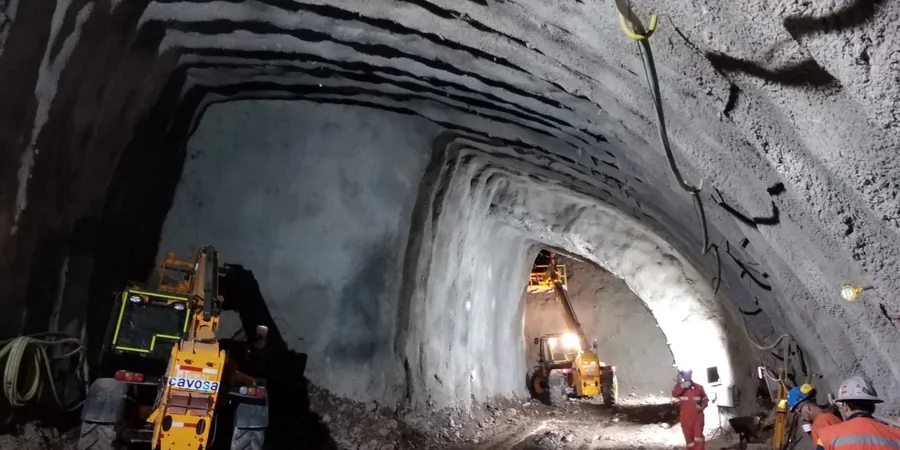
Local context
The contrast between Southsea's Wittering Formation sands and the dockyard's alluvial clays defines the risk profile for any tunnel alignment crossing Portsea Island. In the south, loose saturated sands pose a liquefaction concern under seismic loading—Portsmouth sits in a low-to-moderate seismicity zone per BS EN 1998-1, but the presence of the Portsmouth Fault running NNW–SSE through the city introduces a source that cannot be dismissed. In the northern dockyard area, soft normally consolidated clays exhibit time-dependent settlement that continues years after TBM passage; our oedometer data from multiple boreholes along Queen Street show secondary compression indices Cα between 0.008 and 0.022, requiring explicit long-term settlement allowance in the lining design. Mixed-face conditions at the transition between these units—common beneath the Mile End area—demand face support pressure adjustments that can only be calibrated with high-quality laboratory strength data. Face instability in these transitions has been documented during previous infrastructure projects, and the laboratory-derived parameters form the direct input to numerical models using PLAXIS 3D or FLAC3D for stability analysis under partial-face extraction.
Relevant standards
BS EN 1997-2:2007 – Geotechnical design: Ground investigation and testing, BS 5930:2015 – Code of practice for ground investigations, BS 1377-2:1990 – Classification tests (Atterberg, particle density), BS 1377-7:1990 – Shear strength tests (triaxial compression), BS 1377-5:1990 – Compressibility and consolidation (oedometer), CIRIA C760 – Guidance on embedded retaining wall design
Additional services
Advanced Triaxial Testing Programme
Consolidated-undrained and consolidated-drained triaxial compression with pore pressure measurement on 38 mm and 50 mm specimens. Stress paths designed to match EPB face unloading conditions, with post-shear water content profiles to verify drainage conditions during shearing.
Oedometer Consolidation Suite
Incremental loading oedometer tests from 12.5 kPa to 1600 kPa with load-unload-reload cycles to capture the swelling index Cs. Hydraulic conductivity derived from Terzaghi one-dimensional consolidation theory for settlement-time prediction under Portsmouth's variable tidal groundwater regime.
Classification and Index Testing
Full particle size distribution by wet sieving and hydrometer sedimentation, Atterberg limits by cone penetrometer method, bulk density by water immersion, and calcium carbonate content for cemented horizons within the Bracklesham Beds that affect TBM cutter wear rates.
Typical parameters
Common questions
What laboratory parameters are critical for EPB face pressure design?
Undrained shear strength cu from CIU triaxial tests and the effective friction angle φ' are the primary inputs. The coefficient of consolidation cv from oedometer tests controls the rate at which excess pore pressures dissipate around the TBM, which determines whether undrained or drained conditions govern face pressure calculations. For Portsmouth's harbour clays with cv values between 1.5 and 8 m²/year, partially drained behaviour often applies, and we recommend triaxial testing at strain rates calibrated to the expected TBM advance rate of 15-25 mm/minute.
How do you sample soft soils in Portsmouth without disturbing the structure?
We specify thin-walled open-drive samplers (U100 or Shelby tubes) with an area ratio below 10% and an inside clearance ratio between 0.5% and 1.0%, advanced at a continuous push of 100 mm/second. For the very soft alluvial clays near the harbour, piston sampling from boreholes stabilised with polymer drilling fluid provides Class 1 samples to BS EN ISO 22475-1. Samples are wax-sealed on site, transported vertically in cooled containers, and extruded in the laboratory within 48 hours to minimise moisture loss and disturbance.
How much does a tunnel geotechnical laboratory programme cost in Portsmouth?
A comprehensive laboratory testing programme for soft ground tunnel design in Portsmouth typically ranges from £3,800 to £13,630, depending on the number of boreholes, the depth of sampling, and the testing schedule required. A programme covering two to three boreholes with CIU triaxial, oedometer consolidation, and full index testing on 15 to 25 specimens usually falls in the mid-range. The final cost depends on whether advanced tests such as stress-path triaxial or residual strength ring shear are included.
What is the minimum laboratory testing required for a TBM tunnel under Portsmouth?
At minimum, we recommend triaxial compression tests (CIU) on every distinct soil unit encountered, oedometer consolidation tests at representative depths, and Atterberg limit determination with particle size distribution for classification. For a typical alignment of 500 metres crossing three geological units, this translates to approximately 12 to 18 triaxial specimens, 9 to 12 oedometer tests, and full index testing on all samples. This dataset provides the strength and stiffness parameters needed for PLAXIS 2D/3D cross-section models and longitudinal settlement trough analysis.