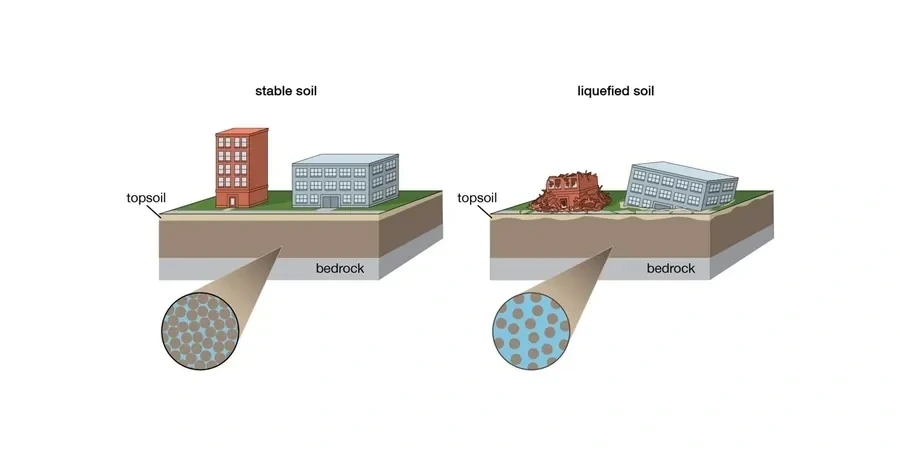
Portsmouth sits on a foundation of reclaimed land, river terrace gravels, and thick estuarine alluvium. The water table across much of Portsea Island is barely two metres below ground level and tidal influence reaches well inland through the harbour inlets. For any significant structure in the city, ignoring the potential for cyclic softening in saturated fine sands during a seismic event is a direct gamble. We run site-specific liquefaction assessments that follow BS EN 1998-5 procedures and pair them with the site investigation data your design team already has. Where boreholes hit loose silty sand between 3 and 12 metres depth, the CPT testing profile often becomes the fastest route to a defensible factor of safety against liquefaction triggering.
In Portsmouth, the combination of shallow groundwater and loose estuarine sand lenses makes liquefaction screening a design necessity, not an academic exercise.
Process overview
Local context
On Portsmouth projects we frequently encounter thin sand seams encased in soft clay that look harmless on a borehole log but become the controlling layer once pore pressure builds during a design earthquake. The classic warning sign is a saturated fine sand with SPT N-values below 10 and fines content under 15 percent. Even if the global slope stability calculation passes, localised lateral spreading toward the harbour basin or the open-cut sections of the M275 corridor can tear through piled foundations. Our reports flag these seams explicitly and recommend either ground treatment or a revised foundation depth. The cost of ignoring a half-metre liquefiable layer discovered during construction far exceeds the budget of the pre-design screening.
Visual overview
Relevant standards
BS EN 1998-5:2004 (Eurocode 8 – Foundations, retaining structures, geotechnical aspects), BS 5930:2015+A1:2020 (Code of practice for ground investigations), BS EN 1997-1:2004 (Eurocode 7 – General rules), BS 1377 (Standard Test Method for SPT) – referenced for SPT N-values, BS 1377 (Atterberg limits) – for fines characterisation in liquefaction assessment
Additional services
Screening-Level Liquefaction Assessment
Desk review of existing borehole logs, SPT N-values, and CPT profiles with a simplified triggering analysis for Portsmouth ground conditions. Delivers a factor-of-safety table per layer and a clear yes-no screening recommendation, suitable for residential and low-rise commercial schemes on Portsea Island.
Full Liquefaction Mitigation Design
Complete cyclic resistance evaluation with laboratory index testing on recovered samples, post-liquefaction settlement and lateral spreading displacement estimates, and performance-based Improvement design. Used for Portsmouth city centre basements, coastal defence structures, and any CC3 consequence-class building.
Typical parameters
Common questions
What triggers a mandatory liquefaction study on a Portsmouth site?
BS EN 1998-5 requires a liquefaction check when the groundwater table is within 15 m of the surface, the design peak ground acceleration exceeds 0.05g, and the soil profile contains saturated sands or silty sands of low plasticity. Virtually all of Portsea Island meets the first two conditions, so the investigation usually turns on whether the boreholes encounter loose granular layers. Our screening starts with that simple three-condition test.
How much does a liquefaction analysis cost for a typical Portsmouth project?
A screening-level analysis built on existing ground investigation data ranges from £2,110 to £3,000 depending on the number of borehole logs and the required deliverables. A full mitigation design with laboratory testing and settlement analysis sits at the upper end of that range. We supply a fixed-price proposal once we review the available site data.
Can you run a liquefaction assessment using CPT data alone?
Yes, and in Portsmouth it is often the most efficient route. A seismic CPTu profile gives continuous soil behaviour type classification, and the Robertson & Wride or Boulanger-Idriss CPT-based procedures derive the cyclic resistance ratio directly from tip resistance and sleeve friction. We still cross-check a few samples for fines content in the lab to tighten the correction, but the CPT-first approach usually avoids the need for multiple SPT boreholes.
What design earthquake magnitude do you use for Portsmouth?
We reference the UK seismic hazard maps and the BS EN 1998-1 design spectra. For most Portsmouth sites the controlling scenario is a moderate-magnitude intraplate event (Mw 5.5–6.0) at shallow depth. Where the project falls under consequence class CC3, we run a site-specific probabilistic seismic hazard assessment to determine the magnitude scaling factor rather than relying on the generic national value.
How long does a liquefaction analysis take from instruction to report?
A screening assessment using existing data typically takes 8–12 working days. If additional site investigation or laboratory testing is needed, the programme extends by the time required for fieldwork and index testing, usually adding 2–3 weeks. We always agree a programme upfront so the structural design team can plan the foundation package without surprises.