In the context of geotechnical engineering, ground improvement encompasses a suite of techniques designed to modify the physical properties of soil and rock to meet the demands of construction. In a coastal city like Portsmouth, where the built environment constantly interacts with complex subsurface conditions, this category is not merely an option but often a necessity. From the historic dockyards to the new residential developments on Portsea Island, the ability to strengthen weak ground, mitigate settlement, and enhance drainage directly underpins the safety, longevity, and economic viability of any project. Without reliable ground improvement, much of the city's ongoing regeneration and infrastructure upgrades would be severely compromised.
Portsmouth's geological setting presents a challenging tapestry for engineers. Much of the city, particularly the densely populated Portsea Island, is underlain by recent superficial deposits including soft alluvial clays, silts, and peat layers associated with the Solent's estuarine environment. These materials are inherently compressible and have low bearing capacity. Beneath these, the solid geology transitions to the Lambeth Group and the chalk of the White Chalk Subgroup, which, while more competent, can feature solution features and variable weathering profiles. The high water table, so close to sea level, introduces additional complexities for excavation stability and buoyancy control, making dewatering and the densification of loose granular fills critical considerations.
Any ground improvement scheme in the UK must strictly adhere to the robust framework of British Standards and Eurocodes. The overarching standard is BS EN 1997-1:2004+A1:2013 (Eurocode 7: Geotechnical design), which mandates a limit state design philosophy and rigorous site investigation to BS EN 1997-2:2007. Execution of specific techniques is governed by BS EN 14731:2005 for deep vibration methods. Crucially, the specification for ground treatment must align with the ICE Specification for Ground Treatment, a cornerstone document in UK practice. These regulations ensure that designs are validated, materials are tested, and works are verified through post-construction testing like plate load tests or cone penetration tests, providing assurance that the improved ground meets the required performance criteria.
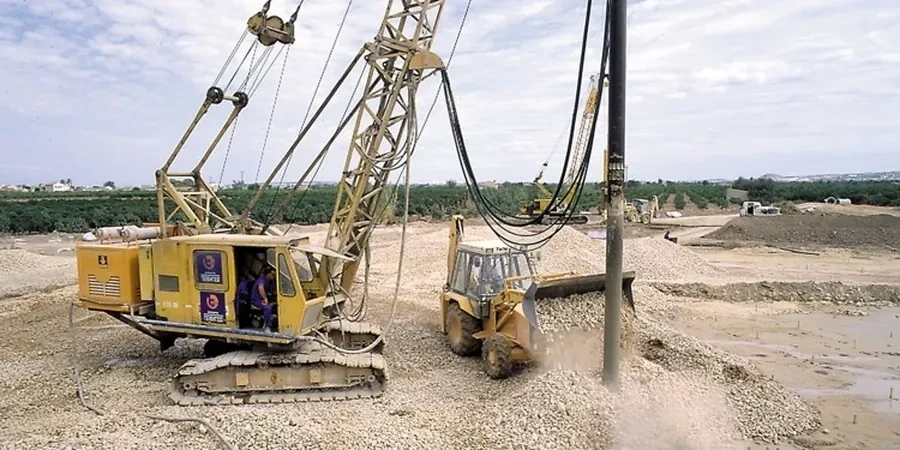
The types of projects in Portsmouth that demand ground improvement are diverse. The construction of new waterfront apartment blocks and commercial spaces on reclaimed or low-lying land routinely requires techniques to control total and differential settlement. Infrastructure projects, such as the expansion of port facilities or the construction of new flood defence walls, often rely on stone column design to reinforce soft cohesive soils and supply a drainage path to accelerate consolidation. For the densification of loose, granular soils found in natural sand deposits or uncompacted fills, vibrocompaction design offers a rapid and effective solution to prevent liquefaction and increase bearing capacity. Even smaller-scale works, like industrial units or road embankments over soft ground, benefit from these technologies to avoid costly deep foundations.
Available services
Common questions
What is the primary purpose of ground improvement in Portsmouth's coastal environment?
The primary purpose is to mitigate the risks posed by the region's soft alluvial clays, silts, and high groundwater table. Techniques are employed to increase soil bearing capacity, reduce total and differential settlement, and accelerate the consolidation of compressible layers, ensuring that structures built on these challenging soils remain safe and stable for their entire design life.
How do British Standards regulate ground improvement works?
Works are regulated through a hierarchy of standards, principally Eurocode 7 (BS EN 1997) which covers geotechnical design and requires a limit state approach. Execution standards like BS EN 14731 for deep vibration, coupled with the ICE Specification for Ground Treatment, dictate strict control over design methodology, material quality, and post-installation verification testing to ensure compliance.
When is ground improvement a more suitable solution than traditional piling?
Ground improvement is often preferable when the problem is the mass behaviour of a soil layer, rather than transferring loads to a deep bearing stratum. It can treat large areas economically, improve ground for floor slabs and pavements simultaneously, and avoid the need for extensive pile caps and structural connections, making it a highly efficient solution for treating weak, compressible soils across a whole site.
What are the key factors in selecting between different ground improvement techniques for a site?
Selection hinges on a detailed ground investigation defining the soil profile, particle size distribution, and groundwater conditions. The structural loading, permissible settlement, project programme, and environmental constraints like vibration sensitivity of nearby structures are critical. This analysis determines whether a technique like vibrocompaction for granular soils or stone columns for cohesive soils is technically and commercially optimal.