On the reclaimed land around Portsea Island and the chalk slopes of Portsdown Hill, achieving specified dry density often hinges on material variability that surprises even experienced groundworkers. Portsmouth's geology shifts abruptly from the Lambeth Group clays beneath the city centre to the thick superficial Head deposits and Upper Chalk, each with a distinct moisture-density relationship that controls the performance of engineered fill. When a site off the M275 corridor fails a nuclear density test, the root cause almost always traces back to a poorly defined compaction curve. Our laboratory runs the Proctor test to BS 1377-4:1990 using both the 2.5 kg and 4.5 kg rammers, providing the target dry density and optimum moisture content that the earthworks specification demands. We correlate these results with grain-size analysis for gradation checks and Atterberg limits when the fines fraction determines the compaction behaviour of the local chalky marl.
A Proctor curve built from fewer than five compaction points misses the moisture sensitivity that makes or breaks a Portsmouth earthworks job.
Process overview
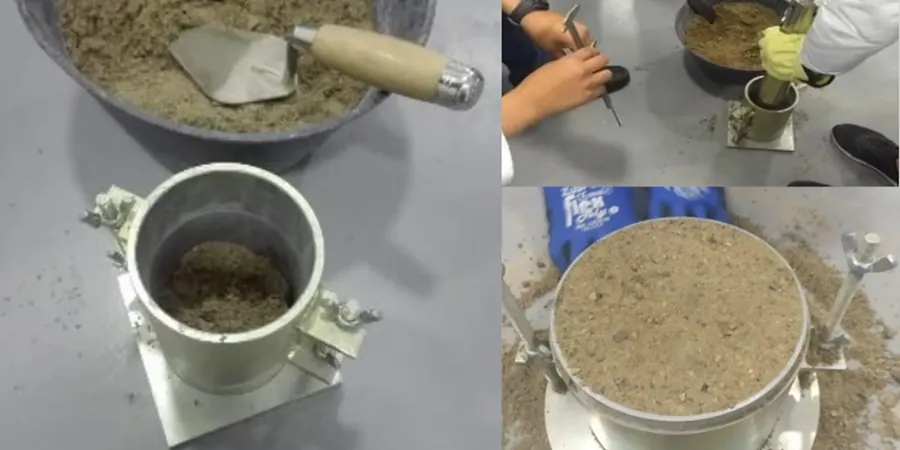
Local context
The most frequent and costly mistake we see on Portsmouth sites is the contractor running a Standard Proctor when the specification—often a highway authority addendum referencing the MCHW Series 600—explicitly requires Modified Proctor effort. Delivering fill compacted to 95% of a Standard MDD when the design assumed Modified effort leaves the pavement formation with a stiffness deficit that manifests as rutting within the first winter of service. Equally damaging is ignoring the chalk's sensitivity to remoulding: Portsdown Hill chalk, when over-compacted wet of optimum, loses its suction and shear strength almost completely, creating a porridge-like failure surface that can destabilise adjoining retaining structures. The other classic trap is using a single Proctor curve for variable site-won material; the Lambeth Group clays across the city can shift optimum moisture content by 3-4 percentage points between adjacent excavations, making a single target density dangerously misleading. A proactive programme of in-situ permeability testing on the compacted lift can also catch layer interfaces that are trapping water before they become failure planes.
Relevant standards
BS 1377-4:1990 — Compaction-related tests, Eurocode 7 (BS EN 1997-2:2007) — Ground investigation for earthworks classification, MCHW Series 600 — Earthworks (Specification for Highway Works), BS 1377-12e2 / D1557-12e1 (equivalent international standards, available on request)
Additional services
Standard & Modified Proctor to BS 1377-4
Determination of the moisture-density relationship using the light (2.5 kg) or heavy (4.5 kg) rammer. Includes oversized particle correction per BS 1377-4:1990 Clause 5.5 where the retained fraction exceeds 5%. Suitable for cohesive and granular fills encountered across the Solent region.
Compaction verification & field density correlation
Laboratory compaction curves delivered alongside field sand replacement or nuclear gauge correlation data. We help earthworks supervisors interpret the 0% and 5% air voids lines so that field density tests can be assessed against the specification acceptance limits in real time.
Typical parameters
Common questions
How much does a Proctor test cost in Portsmouth?
A single-point Proctor compaction test to BS 1377-4 typically costs between £80 and £160, depending on whether the light or heavy effort is specified and the number of compaction points required to define the full curve. A five-point Standard Proctor with moisture content determination falls at the lower end; a full Modified Proctor with oversized particle corrections sits at the upper end. We supply a fixed price before work begins, with no additional charges for the test report or data interpretation.
When should I specify Modified Proctor instead of Standard Proctor for a Portsmouth site?
Modified Proctor (BS heavy effort, 4.5 kg rammer) should be specified whenever the earthworks will be compacted with modern heavy vibratory rollers—which describes virtually all highway embankments, car parks, and industrial slab formations in the Portsmouth area. Standard Proctor more closely represents compaction by older, lighter plant and is now mainly used for landscaping fill, trench reinstatement in footways, or where the specification explicitly permits it. If the contract references MCHW Series 600 or the Design Manual for Roads and Bridges, it almost certainly requires Modified Proctor effort.
How do you handle chalk from Portsdown Hill in the Proctor test?
Chalk presents two specific challenges during compaction testing. First, the particles crush under the rammer, progressively changing the grading during the test itself—we therefore report the final grading after compaction and note the degree of particle breakdown. Second, chalk has a very narrow acceptable moisture range; we plot additional points near the optimum to define the curve shape precisely where it matters most. We also recommend that the Proctor curve be verified against a field compaction trial using the contractor's actual roller, because the laboratory rammer and the site roller produce different degrees of particle crushing.
What sample size do you need for a Proctor test on Portsmouth clay?
For a Standard Proctor using the 105 mm mould, we require approximately 15-20 kg of material passing the 20 mm sieve; for a Modified Proctor with the 152 mm mould, the requirement increases to roughly 35-40 kg. The sample must be taken from a representative bulk excavation, sealed immediately to preserve the natural moisture content, and delivered to the lab within 24 hours. If the material contains particles larger than the mould-specific maximum size, we can apply the oversize correction, but we need an additional 5-10 kg of the coarse fraction for specific gravity determination.