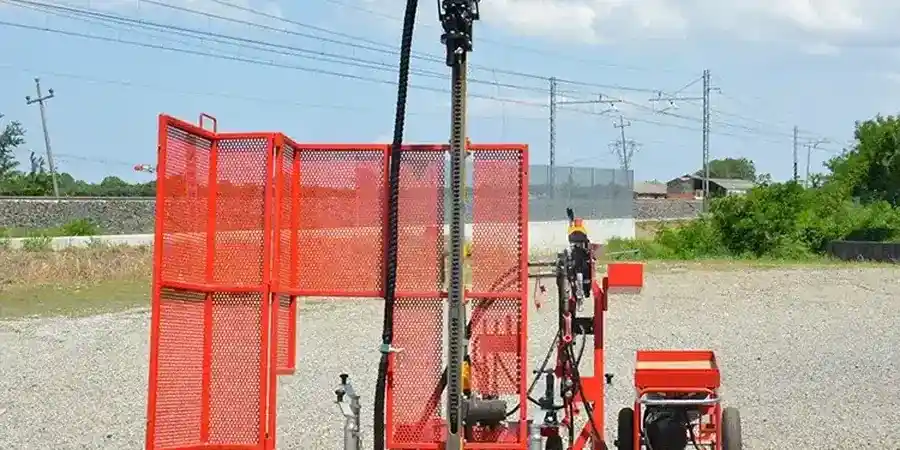
A recent project near the Historic Dockyard required piling depths below the made ground that covers much of Portsea Island. The contractor had assumed chalk at 6 metres. We mobilised a Dando 2000 rig to a tight access site off Queen Street and ran a series of SPTs. The split-spoon sampler revealed soft alluvial clays persisting to 9 metres before hitting the bedrock. Without that sequence of blows, the pile design would have been dangerously short. Portsmouth sits on a complex mix of Quaternary brickearth, raised beach deposits, and the Lambeth Group, with the Wittering Formation outcropping across the northern mainland. Every borehole here tells a different story. Our lab in Fareham processes the disturbed samples alongside the N-value logs, providing a complete stratigraphic and strength profile for your structural engineer within a week.
N-value alone is not a design parameter. In Portsmouth's made ground and harbour silts, the energy transfer ratio and borehole diameter make the difference between a safe bearing pressure and a settlement problem.
Process overview
Local context
The most misleading ground on the south coast is Portsmouth's reclamation fill. The city expanded seaward for centuries, and the old creek lines under Commercial Road and the Tricorn site are backfilled with a chaotic mix of brick, ash, and dredged silt. An SPT in this fill can jump from N=4 to N=40 in 300 mm if the sampler hits a Victorian coping stone. The risk is misinterpreting a refusal on an obstruction as the bearing stratum. We log every 75 mm of penetration and note the drive weight and casing torque. Where the natural ground is the Lambeth Group Clay, the real hazard is softening. If you leave an open borehole overnight, water ingress can halve your N-value by morning. Our crew completes the SPT, backfills with bentonite pellets, and moves off the same day. In the harbour approaches, where tidal variations exceed 4 metres, we have also seen artesian conditions in the chalk, which can blow the casing if not identified early.
Visual overview
Relevant standards
BS 5930:2015+A1:2020 – Code of practice for ground investigations, BS EN ISO 22476-3:2005+A1:2011 – Field testing (SPT), Eurocode 7: BS EN 1997-2:2007 – Ground investigation and testing
Additional services
Rotary Drilled SPT Boreholes
Truck-mounted or restricted-access Dando rigs advancing through made ground with temporary casing. We log the SPT every metre and retrieve disturbed samples for index testing.
Energy Calibration and N60 Correction
Every rig carries a load cell and rod shear-wave velocimeter. We correct raw blow counts to N60 and N1(60) for direct input into your bearing capacity and liquefaction spreadsheets.
Combined SPT and Laboratory Testing
The split-spoon samples go directly to our UKAS-accredited lab for moisture content, Atterberg limits, and particle size distribution. The factual report ties the N-value log to the soil description on the same page.
Typical parameters
Common questions
How much does an SPT investigation cost in Portsmouth?
For a typical residential project with two 10-metre boreholes on Portsea Island, the total cost ranges from £400 to £590. This includes the rig mobilisation, the SPT testing at 1-metre intervals, and the factual report with soil descriptions. Deep boreholes in chalk or sites requiring traffic management will increase the cost.
What is the difference between N60 and N1(60) in your Portsmouth reports?
N60 is the field blow count corrected for hammer energy efficiency. Our automatic trip hammers typically run at 85–92% efficiency, so the raw count is reduced. N1(60) further normalises N60 to an effective overburden pressure of 100 kPa. In Portsmouth's loose harbour sands at 2 metres depth, the overburden correction can reduce your N60 by 20% or more. We supply both values in the borehole log.
Can you drill an SPT borehole in a back garden or basement in Portsmouth?
Yes. We use a restricted-access Dando Terrier rig that fits through a standard 800 mm gate opening. For basements on Albert Road or terraced streets in Southsea, we can set up on a hardstanding area of 2 m by 1.5 m. The rig is rubber-tracked and can climb a 25-degree slope. We have completed SPT investigations inside lock-up garages and under low-headroom railway arches.
How does the SPT distinguish between Portsmouth's chalk and the overlying clay?
The SPT behaves very differently in these two materials. In the stiff Lambeth Group Clay, you get steady N-values of 15 to 30 with a consistent 150 mm seating drive. In weathered chalk, the N-value climbs rapidly, often reaching refusal (50 blows for 50 mm penetration) within 200 mm. The sampler also brings up chalk putty or angular flint nodules, which are unmistakable. We log the colour change from grey-brown clay to white/light grey chalk and note any flint bands. More info.